Telecom infrastructure construction in Nigeria is increasingly distributed across many locations rather than concentrated on a single large construction site. New tower foundations, equipment shelters, network expansion sites, and supporting structures may be built across urban districts, peri-urban areas, and remote communities. Each location can present a different combination of road access, working space, soil conditions, concrete demand, and distance from commercial concrete suppliers. Concrete pumping provides a practical way to separate concrete delivery from the final placement point. Instead of requiring a mixer truck to approach every foundation directly, contractors can establish a controlled route for concrete from the discharge position to the required location.
This distinction becomes particularly important when telecom contractors manage numerous relatively small foundations. The concrete volume at each site may not justify a large permanent production facility, yet the foundation still requires consistent placement and proper consolidation. Concrete pumping equipment in Nigeria can therefore become part of a distributed construction workflow, allowing contractors to adapt concrete placement to the geometry and accessibility of individual sites. Equipment selection should be based on foundation volume, pumping distance, aggregate characteristics, access conditions, and the expected sequence of construction rather than simply on maximum pump output.
Why Distributed Telecom Sites Create Concrete Placement Challenges
Telecom Foundations Are Often Located in Constrained Work Areas
A tower foundation may be surrounded by existing buildings, fences, utility infrastructure, roads, or undeveloped ground. The concrete truck may reach the general project area but still be unable to position itself beside the excavation. In these situations, pumping provides a bridge between vehicle access and the actual foundation.
The contractor can position the delivery vehicle where access is practical and route concrete through a pipeline toward the excavation. This arrangement reduces the need for repeated vehicle maneuvering and can keep the foundation area clearer for reinforcement installation, formwork, inspection, and concrete placement.

Multiple Sites Require a Flexible Construction Workflow
Telecom deployment often involves a sequence of geographically separated locations. One foundation may be inside a city, while the next could be beside a highway or in a semi-rural community. A fixed concrete supply arrangement may therefore be less adaptable to changing site conditions.
Access Conditions Should Be Assessed Before Equipment Selection
Before choosing pumping equipment, contractors should identify the available entrance, truck stopping position, pump location, pipeline route, foundation dimensions, and required concrete volume. These details determine whether a small concrete pump for sale, trailer-mounted system, or larger pumping configuration is appropriate.
How Pumping Equipment Adapts to Different Telecom Projects
Line Pumping Separates Concrete Delivery From Placement
When searching for a concrete pump for sale in Nigeria, telecom contractors should examine more than the equipment’s nominal capacity. The pump must be compatible with the foundation’s concrete mix, aggregate size, pipeline diameter, pumping distance, and placement rate. For compact tower foundations, the ability to position the pump conveniently can be more important than having excessive output.
Mixer Pumps Combine Concrete Preparation and Placement
Some distributed projects face another logistical issue: reliable ready-mix supply may not be readily available near every construction location. In this situation, concrete mixer pump sales in Nigeria can provide an alternative equipment route by combining concrete mixing and pumping functions. The contractor can prepare concrete closer to the foundation and pump it directly to the placement area, reducing dependence on a separate mixer truck and pumping unit.
Production Should Match the Foundation Pour
Telecom foundations are usually defined by their structural requirements and site-specific dimensions. Contractors can calculate the approximate concrete volume before selecting equipment and then compare it with the expected production and pumping rate. The aim is a steady flow of concrete that the placing crew can consolidate and finish without prolonged interruptions.
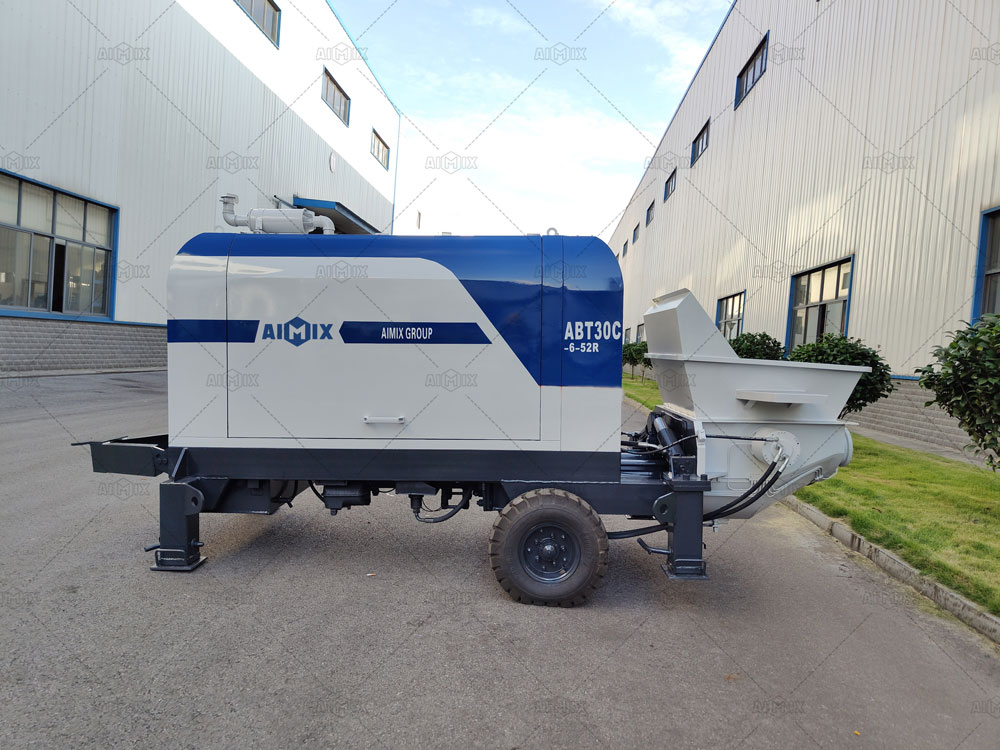
Using Concrete Pumps for Remote and Urban Telecom Sites
Compact Pumping Can Help on Small Urban Sites
Urban telecom construction may involve particularly restricted access. A concrete pumping machine in Nigeria can allow the pump to remain at an accessible point while concrete travels through a delivery line to the foundation. This can be useful when the excavation is separated from the road by buildings, temporary barriers, or limited maneuvering space.
Pipeline positioning should be planned carefully. Excessive bends, unsupported sections, and unnecessary changes in direction can make pumping more complicated. The route should also leave sufficient clearance for workers and other construction activities.
Stationary Pumps Can Support Repeated or Larger Concrete Operations
For larger telecom compounds, network infrastructure projects, or construction programs with substantial and repeated concrete demand, stationary concrete pumps for sale in Nigeria may be considered. A stationary configuration can remain positioned at a designated pumping point while concrete is supplied from mixer trucks or an on-site production system.
Pipeline Planning Becomes More Important as Distance Increases
Longer pumping routes require closer attention to pipeline diameter, vertical elevation, bends, concrete workability, and pump pressure. A longer route does not simply mean adding more hose. The entire pumping circuit should be designed around the concrete characteristics and required delivery conditions to maintain stable flow.
Coordinate Concrete Pumping With Foundation Construction
Reinforcement and Anchor Components Must Be Ready Before the Pour
Concrete pumping works best when the receiving foundation is fully prepared before material arrives. Reinforcement cages, formwork, embedded components, and tower anchor bolts should be checked against the engineering drawings. Once concrete placement starts, stopping for unfinished preparatory work can disrupt the planned sequence.
Concrete Placement and Consolidation Must Progress Together
The pump operator and placing crew need to work as a coordinated unit. Concrete should be placed progressively while workers consolidate it around reinforcement and embedded components. The discharge position can be changed as the foundation fills, helping maintain an orderly placement sequence and limiting unnecessary accumulation in one area.
Cleaning and Relocation Should Be Part of the Workflow
Distributed telecom projects often require small concrete pump equipment to move from one location to another. Cleaning procedures, pipeline management, transport arrangements, and access for the next site should therefore be considered before the current pour begins. Efficient relocation is not an afterthought; it is part of maintaining continuity across a multi-site construction program.
Concrete pumping supports distributed telecom infrastructure by creating a flexible link between where concrete can be delivered or produced and where the foundation must be constructed. For Nigerian contractors, the appropriate arrangement depends on site access, foundation volume, pumping distance, concrete characteristics, equipment mobility, and the scale of the deployment program. When these factors are evaluated together, pumping can become a practical component of a repeatable workflow for constructing foundations across geographically dispersed telecom sites.