Mobile boat lifts, also known as boat travel lifts, are widely used in marinas, shipyards, fishing ports, and boat maintenance facilities for lifting, transporting, launching, and storing vessels. One of the most important advantages of a mobile boat lift is its ability to accommodate a wide variety of boats, from small recreational vessels and fishing boats to luxury yachts, catamarans, patrol boats, and commercial workboats.
However, vessels differ significantly in size, hull shape, weight distribution, draft, and structural design. Handling these diverse vessel types safely requires more than lifting capacity alone. Modern mobile boat lifts incorporate a range of structural features specifically designed to adapt to different boats while maintaining lifting stability, operational safety, and efficiency.
This article explores the key structural features that enable mobile boat lifts to handle different boat types effectively.
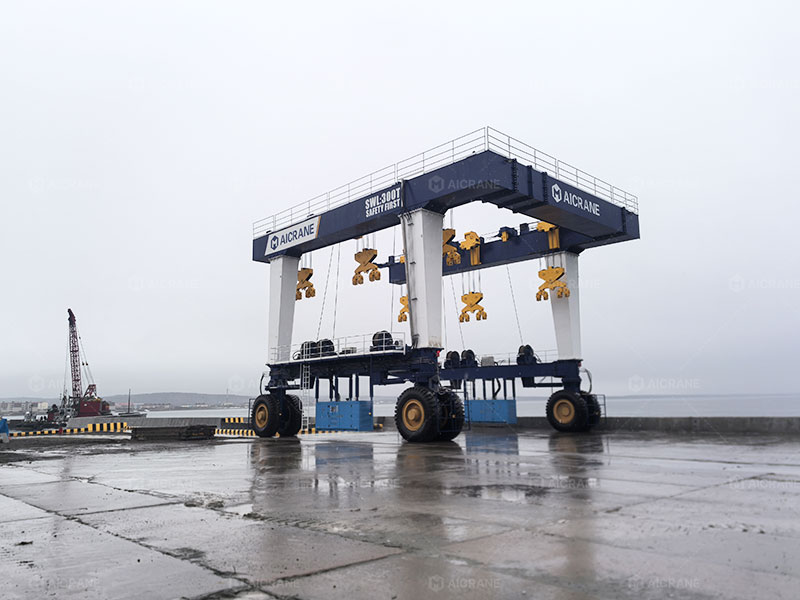
Understanding the Challenges of Handling Different Boat Types
Before examining the structural solutions, it is important to understand why vessel diversity creates lifting challenges.
Different vessels present different handling requirements:
- Sailing yachts often have deep keels that require special sling positioning.
- Catamarans feature twin hulls and wide beam dimensions.
- Fishing vessels may have uneven weight distribution due to onboard equipment.
- Luxury yachts often have sensitive hull finishes requiring precise support.
- Workboats and patrol vessels can have reinforced hull structures and concentrated loads.
- Commercial vessels may exceed standard beam widths and require customized lifting arrangements.
Without adaptable structural designs, lifting these vessels could result in instability, excessive stress on the hull, or inefficient operations.
Adjustable Sling System for Hull Adaptability
One of the most important structural features of a mobile boat hoist is its adjustable sling arrangement.
The lifting slings directly support the vessel during lifting and transportation. Since hull shapes vary significantly, the sling system must be capable of accommodating different configurations.
Modern mobile boat lifts typically feature:
- Adjustable sling spacing
- Movable sling positions along the beam structure
- Multiple sling attachment points
- Quick-adjustment mechanisms
These features allow operators to position the slings according to the vessel’s center of gravity and hull geometry.
For example, a sailing yacht with a deep keel requires different sling placement than a flat-bottomed fishing boat. The adjustable sling system ensures proper load distribution while minimizing stress on the hull.
Wide-Span Gantry Structure
Boat widths can vary dramatically depending on vessel type.
A compact recreational boat may have a narrow beam, while a catamaran or large yacht may require significantly greater clearance.
To accommodate these differences, mobile boat lifts are designed with wide-span gantry structures.
Key advantages include:
- Increased clearance for wide-beam vessels
- Improved accessibility around different hull designs
- Enhanced lifting stability
- Greater flexibility for future vessel requirements
Some high-capacity 100 to 1200 ton travel lifts are custom-designed with extra-wide spans specifically for catamaran handling applications.
The structural rigidity of the gantry frame ensures that lifting forces remain evenly distributed even when handling vessels with large beam dimensions.
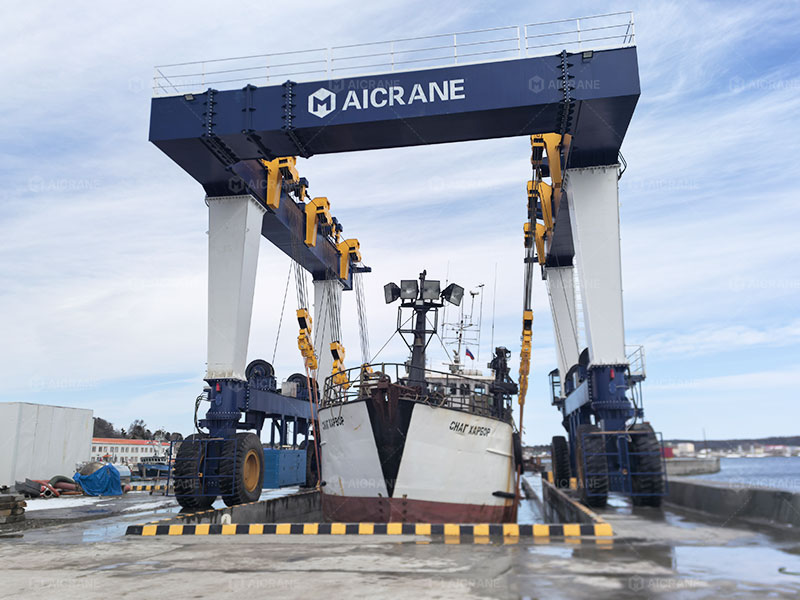
High-Strength Steel Frame Construction
Different boat types generate different loading patterns on the lifting structure.
To safely accommodate varying load conditions, mobile boat lifts are typically manufactured using high-strength structural steel.
Benefits of high-strength steel construction include:
- Higher load-bearing capacity
- Reduced structural deformation
- Improved fatigue resistance
- Greater operational reliability
- Longer service life
The rigid frame design helps maintain structural integrity regardless of whether the lift is handling a lightweight yacht or a heavy commercial vessel.
This versatility is particularly important for marinas and shipyards serving multiple customer segments.
Multiple Lifting Point Configuration
A vessel’s weight is rarely distributed evenly.
Engines, fuel tanks, generators, equipment, and superstructures can create concentrated loads in specific areas of the boat.
Mobile boat lifts address this challenge through multiple lifting point configurations.
Structural features often include:
- Multiple hydraulic lifting units
- Independent lifting points
- Synchronized lifting mechanisms
- Load-sharing systems
These configurations allow lifting forces to be distributed more evenly across the vessel.
As a result, operators can safely lift boats with varying weight distributions while reducing the risk of hull distortion.
Synchronized Hydraulic Lifting Structure
The hydraulic lifting system is another critical structural component that enhances vessel adaptability.
Modern mobile boat lifts typically utilize synchronized hydraulic lifting systems that coordinate multiple lifting points simultaneously.
Structural advantages include:
- Uniform lifting speed
- Balanced load distribution
- Reduced vessel movement
- Improved operational safety
When lifting boats with unusual hull shapes or uneven weight distribution, synchronized hydraulic control ensures that all lifting points rise at the same rate.
This minimizes twisting forces that could potentially damage the vessel.
Adjustable Ground Clearance Design
Different vessels require varying transportation heights during movement within a marina or shipyard.
Mobile boat lifts often feature adjustable lifting heights and transport clearances.
This structural flexibility allows operators to:
- Accommodate deep-keel sailboats
- Transport tall vessels safely
- Navigate uneven yard surfaces
- Position vessels accurately in storage areas
Higher clearance is particularly beneficial when handling sailboats with large keels or specialized commercial vessels.
Independent Wheel and Steering Systems
Boat handling often occurs in confined marina environments where maneuverability is essential.
Modern mobile boat lifts utilize independent wheel and steering structures that improve flexibility when transporting different vessel types.
Features may include:
- Four-wheel steering
- Eight-wheel steering
- Crab steering
- Pivot steering
- Independent wheel drive systems
These steering configurations enable precise positioning regardless of vessel size.
For example, a large yacht may require careful maneuvering between storage rows, while a catamaran may need additional turning clearance.
Advanced steering systems help operators transport vessels safely and efficiently.
Modular Structural Design
Many manufacturers like Aicrane now utilize modular structural designs to increase adaptability.
Modular construction allows mobile boat lifts to be customized according to operational requirements.
Possible customizations include:
- Capacity upgrades
- Span modifications
- Additional lifting points
- Specialized sling systems
- Enhanced wheel configurations
This flexibility enables operators to handle a broader range of vessel types without investing in multiple lifting systems.
As marina requirements evolve, modular structures can often be adapted to accommodate larger or more specialized boats.
Corrosion-Resistant Structural Features
Mobile boat lifts frequently operate in harsh marine environments where exposure to saltwater, humidity, and UV radiation can accelerate structural degradation.
To ensure reliable handling of various vessel types over the long term, manufacturers incorporate corrosion-resistant structural features such as:
- Marine-grade protective coatings
- Hot-dip galvanized components
- Corrosion-resistant fasteners
- Weather-resistant hydraulic system protection
These features help preserve structural integrity and maintain lifting performance throughout the equipment’s service life.
Reliable structural performance is especially important when handling high-value yachts and commercial vessels.
Load Monitoring and Structural Protection Systems
Modern mobile boat lifts increasingly integrate structural monitoring technologies that improve safety when handling diverse vessel types.
These systems may include:
- Load monitoring sensors
- Hydraulic pressure monitoring
- Overload protection systems
- Real-time weight distribution analysis
- Structural stress monitoring
By continuously monitoring lifting conditions, operators can identify potential imbalances before they become safety concerns.
This capability is particularly valuable when lifting unfamiliar vessel designs or boats with complex weight distributions.
Custom Structural Solutions for Specialized Vessels
Some vessels require customized lifting arrangements beyond standard travel lift configurations.
Examples include:
- Catamarans
- Military patrol vessels
- High-speed ferries
- Research vessels
- Offshore support boats
For these applications, manufacturers may provide customized structural solutions such as:
- Extended-span frames
- Reinforced beam structures
- Specialized sling systems
- Additional lifting points
- Enhanced wheel configurations
These customizations ensure that the lift can safely accommodate unique vessel geometries and operational requirements.
Conclusion
The ability of a mobile boat lift to handle different boat types depends largely on its structural design. Features such as adjustable sling systems, wide-span gantry frames, synchronized hydraulic lifting structures, multiple lifting points, independent steering systems, and modular construction provide the flexibility needed to accommodate a broad range of vessels.
As marinas, shipyards, and boat service facilities continue to serve increasingly diverse fleets, adaptable structural designs have become essential for maintaining safety, efficiency, and operational versatility. By investing in a mobile boat lift equipped with these advanced structural features, operators can confidently handle everything from small recreational boats to large commercial vessels while protecting both equipment and valuable marine assets.