In the planning and optimization of container terminals and port logistics, maximizing throughput efficiency while reducing operating expenses remains the primary objective. However, many terminal operators consistently experience operational bottlenecks arising from the coordination of too many different equipment types.
The traditional container handling workflow typically relies on a divided system: Quay Cranes (QCs) handle ship-to-shore transfer, Internal Terminal Vehicles (ITVs) or Automated Guided Vehicles (AGVs) perform horizontal transport, and Rubber-Tyred Gantry (RTG) or Rail-Mounted Gantry (RMG) cranes manage vertical stacking in the yard. While this multi-equipment setup is effective for ultra-large, ultra-high-throughput terminals, it often introduces systematic delays, mutual equipment waiting times, and high maintenance costs in mid-sized terminals or yards requiring higher flexibility.
Deploying a single fleet of Straddle Carriers – which integrates horizontal transport and vertical stacking into a single type of machinery—effectively addresses these operational challenges. This article provides an objective analysis of how this single-equipment fleet model reduces infrastructure investment, streamlines workflows, and optimizes the Total Cost of Ownership (TCO).
1. Limitations of the Traditional Multi-Equipment Model
To understand the integration benefits of straddle carriers, it is essential to evaluate the limitations of the traditional “truck + gantry crane” model in daily operations:
1.1 High Infrastructure Capital Expenditure (CapEx)
RMGs and RTGs exert massive concentrated wheel loads on the ground. Terminals must invest heavily in constructing deep, reinforced concrete foundations or laying specialized steel tracks, resulting in exceptionally high initial civil engineering costs.
1.2 Rigid Equipment Coupling and Idle Bottlenecks
In a multi-equipment system, the operations of trucks and yard gantry cranes are strictly interdependent. A terminal truck must park in a designated lane and wait for the gantry crane to align, grab, or place the container. If yard stacking operations experience delays, trucks queue up in the travel lanes, which reduces vehicle utilization and increases unnecessary fuel consumption and emissions.
1.3 Maintenance and Management Complexity
Operating both terminal trucks and large port gantry cranes simultaneously requires the terminal to procure and stock two completely different sets of spare parts. It also necessitates training two separate groups of technical staff with distinct operating qualifications, which increases administrative costs and limits scheduling flexibility during labor shortages.
2. Technical Integration of Transport and Stacking
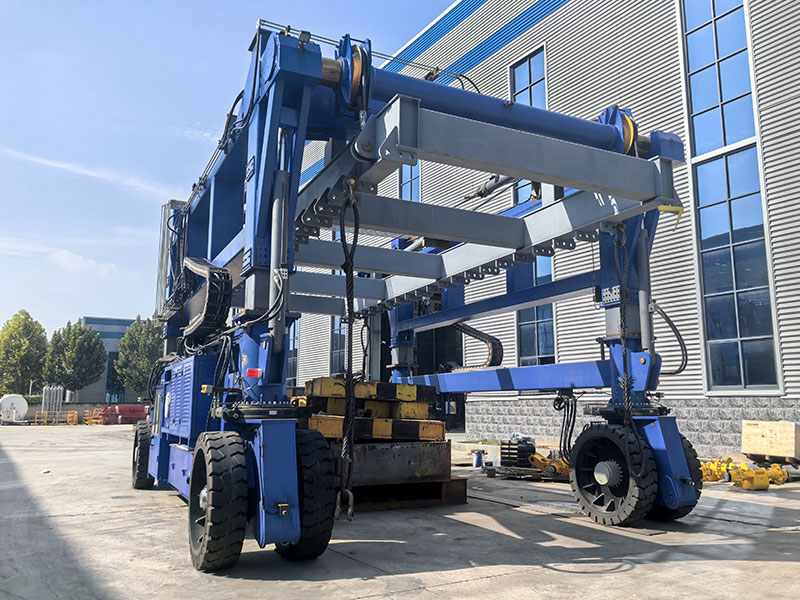
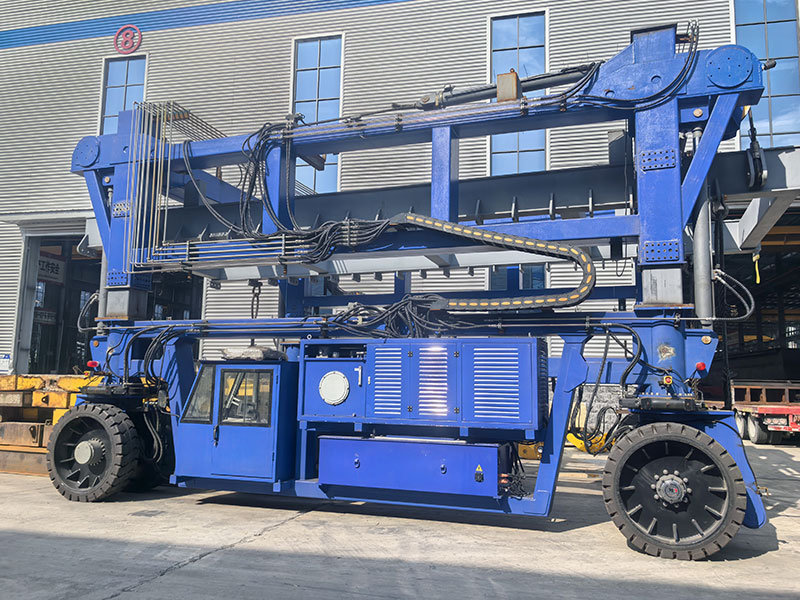
A straddle carrier is a heavy-duty mobile unit designed to position itself directly over a container, utilizing an onboard telescopic spreader to lift, transport, and stack containers independently. This single-vehicle process decouples the terminal handling steps:
- Autonomous Pickup: The straddle carrier picks up containers directly from the quay crane buffer area or transfer zones without requiring a truck to be positioned beneath it.
- Rapid Transit: Once the load is secured, the straddle carrier can travel horizontally across the terminal at speeds up to 30 km/h.
- Direct Yard Stacking: Upon reaching the designated stack slot, the vehicle deposits the container vertically. Current standard models can stack containers in 1-over-2 (3 tiers high) or 1-over-3 (4 tiers high) configurations.
By utilizing a single machine to manage the entire cycle – from initial hoisting and transit to final positioning – the intermediate handovers between transport vehicles and yard container gantry cranes are eliminated. This operational independence prevents the common bottleneck of cranes waiting for trucks, or trucks waiting for cranes.
3. Core Economic and Operational Benefits of a Single-Type Fleet
Standardizing terminal yard operations around a single fleet of straddle carriers provides several practical operational advantages:
3.1 Lower Civil Engineering Costs and Enhanced Yard Flexibility
Compared to traditional yard gantry cranes, straddle carriers distribute wheel loads more evenly across multiple large tires, significantly reducing local bearing pressure on the pavement. Consequently, operators do not need to construct expensive gantry rail foundations or perform high-specification deep soil stabilization. Additionally, because straddle carriers operate without fixed rails, the terminal layout and travel routes can be modified at any time with minimal cost to accommodate seasonal volume changes or routing adjustments.
3.2 Standardized Maintenance and Reduced Total Cost of Ownership (TCO)
Simplifying the fleet composition directly lowers operational expenditures (OpEx):
- Standardized Spare Parts Inventory: Procurement teams only need to source and manage parts for a single equipment type, which substantially reduces capital tied up in diverse spare parts inventory.
- Consolidated Technical Training: Maintenance technicians only need to master the mechanical, hydraulic, and electrical systems of one machine type. This concentration of expertise improves diagnostic accuracy and shortens the Mean Time to Repair (MTTR).
- Minimized Idle Fuel Consumption: The adoption of hybrid and battery-electric straddle carriers continues to grow. By removing the need for terminal trucks to idle in queue lines under gantry cranes, the fleet’s overall energy efficiency is measurably improved.
3.3 Optimized Land Utilization and Yard Stacking Density
Although RMG or RTG gantry cranes offer higher maximum stacking heights, straddle carriers provide excellent space efficiency relative to their footprint and cost. Unlike reach stackers, which require wide drive aisles to extend their booms laterally, a straddle carrier travels directly over the stacks. The required aisle width is only slightly wider than the vehicle chassis itself, allowing terminals to design narrower lanes and increase the static container storage capacity per hectare.
3.4 Gradual and Cost-Effective Automation Paths
Because a straddle carrier is already an integrated, self-powered unit of work, it offers a highly manageable path toward automation. Terminal operators can implement upgrades incrementally – starting with manual operations, introducing automated steering and positioning aids, and eventually transition to a fully Automated Straddle Carrier (A-SC) fleet. This phased approach avoids the widespread operational shutdowns and system re-engineering typically required by large-scale gantry crane automation projects.
Conclusion
For modern container terminals and logistics hubs focused on lean operations and capital efficiency, simplifying fleet diversity is directly linked to long-term profitability.
Operating a single fleet of straddle carriers to handle both horizontal transport and yard stacking is a highly practical strategy that balances initial capital investments with ongoing operational efficiency. This model systematically bypasses the coordination bottlenecks inherent in traditional multi-equipment setups, while simplifying maintenance and yard management. In a highly volatile global trade environment, this modular and autonomous approach provides terminals with the operational resilience needed to manage throughput fluctuations and transition smoothly toward low-emission, automated futures.