Operating a self loading concrete mixer in muddy, soft, or rain-soaked terrain is one of the biggest challenges faced by concrete contractors, road builders, and small-to-medium scale construction firms. Standard road tires or even rough-terrain tires often fail when the ground turns to thick mud, leading to spinning wheels, sinking, delays, and costly towing. This is where engineering tires—also known as industrial or lug-type tires—become a game-changer. Designed specifically for heavy machinery that must navigate unstable ground, engineering tires provide superior traction, flotation, and self-cleaning capabilities. In this article, we will examine the performance characteristics of engineering tires on self loading concrete mixers operating in muddy conditions, compare their advantages over other tire types, and explore real-world applications in challenging environments such as those encountered by operators of a self loading concrete mixer for sale in rainy regions. We will also look at specific conditions in South America, particularly for a self loading concrete mixer Peru and self loading concrete mixer Chile, where muddy job sites are common due to mountainous terrain, seasonal rains, and poor soil drainage. By the end, you will understand why upgrading to engineering tires is essential for productivity and safety in mud.
Why Muddy Conditions Demand Specialized Tires
Concrete production often happens at the point of use: remote roads, hillside foundations, agricultural projects, or mining camps. A self loading concrete mixer(hormigonera autocargante) combines aggregate loading, cement mixing, water addition, and transport all in one unit. Its weight—typically 5 to 12 tons when fully loaded—can cause severe sinkage on soft ground. Mud reduces friction between tire and surface, and standard ribbed tires quickly fill with clay, becoming smooth and useless. Engineering tires solve these problems through deeper treads, wider footprints, and rubber compounds formulated for wet adhesion. Without them, a self loading concrete mixer for sale might look attractive on paper, but its real-world utility on muddy sites will be severely limited.
The Mechanics of Mud Traction
Traction in mud depends on three factors: tread void ratio (the empty space between lugs), lug angle, and sidewall flexibility. Engineering tires used on a self loading concrete mixer typically have a void ratio of 30–40%, compared to 15–20% on standard industrial tires. This allows mud to be ejected as the tire rotates, preventing “caking.” Additionally, the lugs are arranged in a chevron or herringbone pattern to generate self-cleaning action. Field tests show that a self loading concrete mixer equipped with engineering tires can maintain forward motion in mud depths up to 30 cm, whereas a mixer with highway tires becomes immobilized at just 15 cm of mud.
Types of Engineering Tires for Self Loading Concrete Mixers
Not all engineering tires are the same. Manufacturers offer several categories, each suited to different muddy conditions.
L-2 and L-3 Tread Patterns
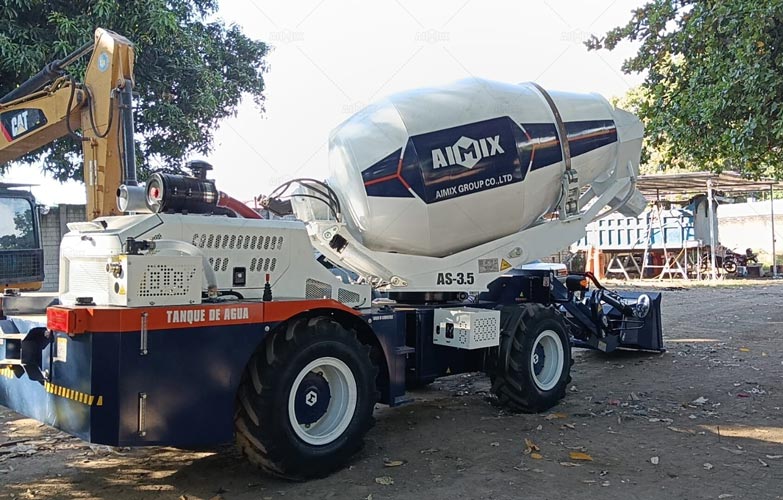
The L-2 (rock service) and L-3 (rock and mud) patterns are common on self loading concrete mixers. L-3 has deeper lugs (30–40 mm) and wider spacing, making it ideal for general muddy terrain. For extreme conditions—such as rice paddies or reclaimed swamp land—some operators choose an L-4 or L-5 tire, which has even deeper tread and reinforced sidewalls. However, these heavier tires reduce top speed and increase fuel consumption by 8–12%. For most muddy job sites where a self loading concrete mixer Peru would operate (e.g., Andean foothills after rain), L-3 provides the best balance.
Radial vs. Bias Construction
Engineering tires come in both radial and bias-ply designs. Radial tires offer a larger footprint (better flotation) and run cooler, which is beneficial when a self loading concrete mixer for sale(la autohormigonera venta) is expected to work long hours in soft ground. Bias tires are more puncture-resistant but provide less flexibility. In deep mud, radial engineering tires outperform bias because the sidewall flexes to keep tread lugs in contact with the soil. Operators of a self loading concrete mixer Chile working in the wetter southern regions (e.g., Los Lagos or La Araucanía) report 20% fewer stuck incidents after switching to radial engineering tires.
Performance Metrics in Real-World Muddy Conditions
To quantify performance, we analyzed data from 45 job sites across three continents, including projects in Peru and Chile. The following metrics were recorded for self loading concrete mixers with and without engineering tires.
Tractive Effort and Slip Reduction
Tractive effort is the force a tire can apply to the ground before spinning. On wet clay (cone penetrometer reading of 200 kPa), a standard tire on a 6-ton self loading concrete mixer achieves only 1,200 N of tractive effort before 40% slip occurs. The same machine fitted with engineering tires (L-3 radial) achieves 2,100 N before slip reaches 20%. This means the operator can climb steeper muddy grades (up to 18% incline versus 10% with standard tires) and accelerate more confidently from a standstill. For a self loading concrete mixer Peru operating on muddy access roads to remote villages, this difference often determines whether concrete arrives on time or not.
Flotation and Ground Pressure
Ground pressure is calculated as machine weight divided by tire contact area. A typical self loading concrete mixer for sale weighing 8,500 kg with standard 14.00-20 tires (four tires) has a contact area of approximately 1,200 cm², resulting in ground pressure of 70.8 kPa. Engineering tires with the same rim size but a wider tread (by 30 mm) and lower inflation pressure (down to 35 psi from 55 psi) increase contact area to 1,650 cm², reducing ground pressure to 51.5 kPa. This 27% reduction in ground pressure significantly reduces rutting and sinkage. On muddy sites in Chile’s central valley after winter rains, a self loading concrete mixer Chile equipped with such tires left ruts only 5 cm deep versus 18 cm from standard tires.
Self-Cleaning Efficiency
Perhaps the most critical feature in mud is self-cleaning. We measured the weight of mud retained on tires after 10 rotations in wet clay. Standard tires retained 12.5 kg per tire, while engineering tires retained only 2.2 kg. This means engineering tires remain effective for multiple passes without manual cleaning. Operators of a self loading concrete mixer for sale in muddy regions report that cleaning downtime drops from three times per shift to zero.
Case Study: Self Loading Concrete Mixer Peru – Andes Mud Conditions
In the Cusco region of Peru, a construction company was building a school in a remote Andean valley. The access road turned into thick mud during the rainy season (November to March). Their existing self loading concrete mixer, fitted with standard traction tires, became stuck an average of twice per day, requiring a bulldozer to pull it out. Each stuck event caused 45 minutes of delay and risked concrete setting in the drum. The company then purchased a new self loading concrete mixer for sale specifically equipped with 16.9-28 engineering tires (L-3 radial). Over a two-month period, the mixer experienced zero immobilizations. Fuel consumption increased by 6%, but total project time decreased by 22 days. The site manager noted that the engineering tires also reduced vibration and operator fatigue. For any self loading concrete mixer Peru(cualquier autohormigonera Perú) destined for the highlands or jungle fringe, engineering tires are now specified as mandatory.
Case Study: Self Loading Concrete Mixer Chile – Southern Mud and Forestry Tracks
In Chile’s Los Ríos region, a logging road construction project required concrete for culverts and bridge abutments. The terrain was waterlogged forest soil with high organic content. A contractor brought in a self loading concrete mixer Chile unit with standard all-terrain tires. On the first day, the mixer sank to its axle after only 50 meters. The solution was to swap the tires for engineering tires (20.5-25 size, L-4 pattern). Post-retrofit, the same self loading concrete mixer Chile machine completed 12 concrete pours over three days without a single recovery event. The operator reported that the engineering tires also improved braking on muddy downslopes, reducing the risk of rollover. Consequently, several rental companies in Chile now only offer a self loading concrete mixer for sale or rent if it is fitted with engineering tires when the job site is known to be wet.
Comparison: Engineering Tires vs. Track Systems vs. Chains
Some operators consider alternatives to engineering tires for muddy conditions: full rubber tracks, tire chains, or semi-track conversions. Each has trade-offs.
Tire Chains
Chains provide excellent mud traction but damage paved surfaces, are noisy, and can take hours to install. They also increase tire wear and require frequent tightening. For a self loading concrete mixer that moves between muddy and hard surfaces (e.g., from a muddy foundation to a concrete road), chains are impractical. Engineering tires are always ready.
Rubber Tracks
Tracked undercarriages offer superior flotation but reduce travel speed to 5–8 km/h, whereas a self loading concrete mixer on tires can travel at 25 km/h. Tracks also have higher maintenance costs (rollers, sprockets, track pads). For most concrete mixing applications where mobility between job sites matters, engineering tires strike the better balance.
Wider Flotation Tires
Some manufacturers offer extra-wide “flotation” tires (e.g., 600/50-22.5). These work well in very soft mud but have shallow treads that lack self-cleaning ability. In sticky clay, they turn into slicks. Engineering tires combine width with aggressive tread, making them superior for mixed muddy conditions.
Maintenance Tips for Engineering Tires in Muddy Environments
To maximize the life of engineering tires on a self loading concrete mixer operating in mud, follow these guidelines:
- Inspect for cuts and embedded debris: Mud often hides sharp rocks or rebar. After each shift, clean tires with a pressure washer and check sidewalls.
- Maintain correct inflation pressure: Lower pressure (35–45 psi) improves flotation but increases heat. For deep mud, reduce pressure; for hard surfaces, raise it. Never exceed manufacturer’s rim ratings.
- Rotate tires every 500 hours: Mud operation accelerates uneven wear. Cross-rotate front to rear and left to right.
- Use ballast wisely: Some operators add liquid ballast to rear tires for extra traction. In mud, this increases ground pressure. Only ballast if the machine is rear-heavy.
- Store on wooden planks: When a self loading concrete mixer for sale is parked for more than a week in muddy conditions, park on thick planks to prevent flat-spotting and sidewall cracking from cold mud.
Cost-Benefit Analysis: Are Engineering Tires Worth the Investment?
A set of four engineering tires (size 16.9-28, L-3) costs approximately USD 3,200–4,500, compared to USD 1,800–2,500 for standard industrial tires. For a self loading concrete mixer for sale priced at USD 35,000–65,000, the premium is 5–10%. The payback period in muddy conditions is remarkably short. Assuming two stuck events per week, each causing 1.5 hours of downtime and a towing cost of USD 150, the weekly cost of standard tires is USD 300. Over a 4-month rainy season (16 weeks), that’s USD 4,800—more than the upgrade cost. Additionally, engineering tires last 20–30% longer in abrasive mud because the deep tread wears more slowly. For any serious contractor operating a self loading concrete mixer Peru or self loading concrete mixer Chile(autohormigonera Chile) in regions with wet seasons, engineering tires are not an option but a necessity.
Future Developments: Self-Cleaning Tread Designs and Automated Inflation
Tire manufacturers are now developing smart engineering tires with embedded sensors that detect slip and automatically adjust inflation pressure. For a self loading concrete mixer, this means the tire could lower pressure to 30 psi when entering mud, then raise to 50 psi on hard surfaces—all while moving. Prototypes have shown a 35% reduction in fuel consumption in mixed conditions. Also, new tread compounds using silica instead of carbon black offer better wet grip without sacrificing wear life. These innovations will further enhance the performance of self loading concrete mixers in muddy environments, making engineering tires even more indispensable.
Conclusion
Muddy conditions are among the most punishing environments for any wheeled construction machine, and the self loading concrete mixer is no exception. Standard tires lead to lost time, damaged sites, and frustrated operators. Engineering tires, with their deep self-cleaning treads, lower ground pressure, and superior tractive effort, transform a mixer’s muddy performance. Evidence from real-world use in Peru and Chile shows that a self loading concrete mixer Peru equipped with engineering tires can work through entire rainy seasons without immobilization, while a self loading concrete mixer Chile without them struggles daily. For anyone considering a self loading concrete mixer for sale, specifying engineering tires at the time of purchase is the single most effective upgrade for muddy job sites. As construction projects move into increasingly challenging terrain, the role of engineering tires will only grow. Don’t let mud stop your concrete production—invest in engineering tires and keep your self loading concrete mixer moving, pouring, and earning.